
When evaluating a front load vs top load washing machine UAE residents face a distinct engineering tradeoff: front loaders deliver superior water and energy efficiency with higher mechanical complexity, while top loaders offer greater structural simplicity with higher water consumption. True long term reliability cannot be evaluated using generic global ratings because the UAE presents unique environmental stressors namely remineralized hard water with 100 to 250 mg/L mineral density, ambient desert dust, and heavy household laundry demands.
Under these local conditions, the two machine types fail through fundamentally different mechanical pathways. Front load washers subject their horizontal drum bearings, rubber door bellows, and heating elements to severe stress from mineral scaling and trapped humidity, often resulting in bearing failure, mold contamination, or heater burnout. Conversely, vertical axis top load washers rely on gravity assisted drainage and open top ventilation, which resists mold and limescale damage effectively, but places sustained mechanical load on drive belts, suspension dampers, and transmission gearboxes.
This technical reliability analysis moves beyond standard brand marketing to evaluate empirical failure rates, component lifespan benchmarks, and repair costs across both designs. By analyzing how desert water chemistry and continuous operational demand degrade each system at a mechanical level, this guide provides homeowners with the data needed to make a sound, long term appliance investment.
Jump to a section:
- How Repair Frequency Compares
- Common Failure Modes by Machine Architecture
- Why UAE Conditions Affect Each Type Differently
- Repair Cost Comparison (AED Rates)
- Which Type Makes More Sense for Different Households?
How Repair Frequency Compares: Front Load vs. Top Load
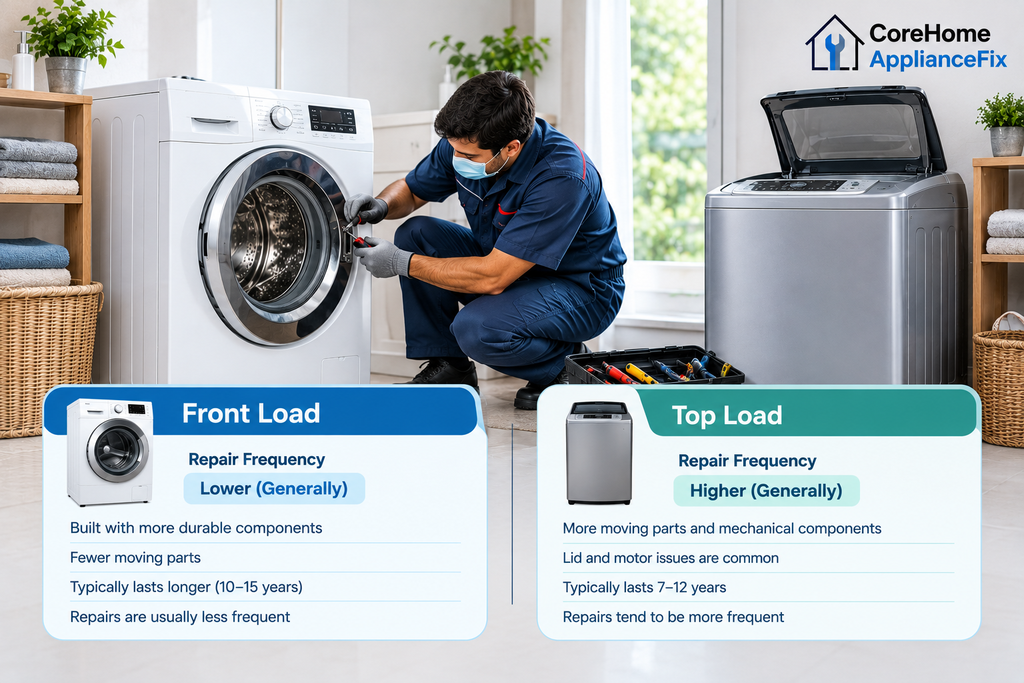
When evaluating washing machine reliability, repair frequency must be balanced against repair severity. Empirical service data indicates that horizontal axis front load machines require service calls roughly twenty to twenty five percent more frequently over a ten year operational lifespan than vertical axis top loaders. However, this higher maintenance rate reflects complex internal mechanics and active user maintenance requirements rather than inferior build quality.
Why Front Load Machines Require More Frequent Service
The higher service rate of front load washers stems directly from their mechanical engineering. Because the drum sits horizontally, the entire weight of wet laundry cantilevers onto a single rear bearing assembly and spider bracket, subjecting it to immense rotational shear force at spin speeds reaching 1,400 RPM.
Furthermore, front loaders operate as sealed, pressurized environments. They rely on an airtight rubber door gasket (bellows) that is susceptible to mold and tearing, complex multi point spring and shock absorber suspension systems, and internal heating elements that are continuously exposed to limescale accumulation from mineral dense water. Each of these components adds a dynamic failure point that demands regular upkeep.
Why Top Load Machines Fail Less Frequently, But More Severely
Top load washers operate on a vertical axis where the weight of the water and clothing is distributed evenly downward via gravity across a symmetrical suspension system. Because the tub remains open to the air and does not require an airtight door seal, top loaders eliminate the most common failure points of front loaders: mold buildup, gasket tears, and bearing shear.
However, when a top load washer does suffer a mechanical breakdown, the failure is often structural. Traditional top loaders utilize mechanical transmissions, drive belts, and heavy duty agitation gearboxes to alternate drum motion. When these heavy core components seize or strip after years of friction, the labor and replacement cost frequently equals or exceeds the total replacement cost of the machine.
The Reliability Pattern
The data reveals a clear divergence between the two designs:
Front load washers represent a higher maintenance, high efficiency design. They deliver superior water savings, lower electrical consumption, and superior fabric care, but they demand proactive user maintenance such as periodic gasket drying, filter cleanouts, and monthly descaling to avoid minor component failures.
Top load washers represent a lower maintenance, mechanical workhorse design. They are far more forgiving of hard water and infrequent cleaning, but their long term mechanical survival relies on avoiding overloaded wash cycles that burn out the drive transmission or snap suspension rods.
Common Failure Modes by Machine Architecture
| Machine Type | Most Common Faults | Less Common But Costly |
| Front Load | Door seal wear/mold, drain pump clogs, drum bearing wear | Suspension spring failure, heating element scale damage |
| Top Load | Agitator/impeller wear, lid switch failure, unbalanced loads | Transmission failure, drive belt failure |
Why UAE Conditions Affect Each Type Differently
Hard Water Hits Front Load Machines Harder
Front load machines typically use less water per cycle, which means the water inside carries a proportionally higher mineral concentration relative to the laundry load. Combined with an internal heating element doing continuous work, front loaders are significantly more susceptible to mineral scaling. To understand how calcium deposits ruin heating elements and pump impellers, read our full guide on how hard water damages your washing machine in Dubai.
Heat and Dust Affect the Motor Differently by Type
Front load machines generally use more efficient, often inverter driven motors that handle heat reasonably well, but their more complex electronics can be more sensitive to dust infiltration over time. Top load machines, particularly older agitator models with simpler motors, tend to be more heat tolerant but can accumulate dust and lint around the transmission area, contributing to premature wear there instead.
Usage Patterns in UAE Households
UAE households, particularly larger families or those with domestic help doing frequent loads, often run washing machines considerably more often than average global usage estimates assume, in line with patterns noted in Dubai Statistics Center’s household composition data.
Door Seal Mold Growth in Humid Conditions
The combination of Dubai’s humidity and a front loader’s airtight rubber door bellows creates an ideal breeding ground for mildew. If your front loading unit has developed a musty or damp odor, consult our dedicated guide on why a washing machine smells in Dubai for step by step seal cleaning and bacterial decontamination routines.
Repair Cost Comparison
Typical Repair Costs by Type
Front load repairs commonly range from AED 200 to 1,800 depending on the fault, with door seal replacement and drain pump clogs on the lower end and drum bearing or suspension repairs on the higher end. Top load repairs commonly range from AED 150 to 1,500, with lid switch and agitator repairs on the lower end and transmission replacement pushing toward the top of that range.
Why the Averages Are Closer Than Repair Frequency Suggests
Even though front load machines need repair more often, the individual repair costs aren’t dramatically higher than top load repairs in most cases, since many of the most common front load faults, seals, drain pumps, are relatively inexpensive fixes. The real cost difference over time comes from frequency rather than the price of any single repair.
The Exception: Major Component Failure
Where the gap widens is major component failure. A front load suspension or heating element failure and a top load transmission failure both sit at the expensive end of their respective repair ranges, and neither type has a clear cost advantage once a repair reaches this scale. At that point, the repair versus replace decision matters more than which type of machine is involved, and a washing machine repair specialist can give an accurate cost comparison for the specific machine rather than relying on general ranges.
Total Cost Over a Typical Ownership Period
Factoring in both frequency and individual repair cost, front load machines tend to accumulate a somewhat higher total repair spend over a 7 to 10 year ownership period in UAE conditions specifically, largely due to hard water and humidity related maintenance needs that top load machines are less exposed to. This gap narrows significantly for front load owners who stay consistent with descaling and seal maintenance routines.
Which Type Makes More Sense for Different Households?
Front Load Makes More Sense If
Water and energy efficiency matter for the household’s utility costs, a gentler wash cycle for delicate fabrics is a priority, and there’s genuine willingness to keep up with the maintenance routine, wiping the seal, monthly descaling, that meaningfully reduces the UAE specific issues covered above. Front load machines reward consistent upkeep more than top load machines do.
Top Load Makes More Sense If
Lower maintenance involvement is the priority, faster individual cycle times matter, or the household prefers being able to add items mid cycle, something front load designs don’t allow once running. Top load machines are generally more forgiving of inconsistent maintenance, since fewer of their common faults are upkeep related in the way front load seal and scale issues are.
For Households With Domestic Help or Very Frequent Use
Larger households running multiple loads daily should weigh the maintenance commitment realistically rather than choosing based on efficiency ratings alone. A front load machine used this heavily needs its maintenance routine followed consistently to avoid the accelerated wear covered earlier, while a top load machine under the same heavy use will more likely show mechanical wear (transmission, belt) sooner than a lightly used one would.
The Honest Bottom Line
Neither type is objectively more reliable in the UAE. Front load machines fail more often but for typically cheaper, maintenance related reasons; top load machines fail less often but sometimes for costlier, mechanical reasons. The better fit depends on how much ongoing maintenance a household is realistically willing to keep up with, not which machine has a lower fault count on paper.
FAQs
Do front load washing machines really need more repairs than top load in the UAE specifically?
Generally yes, primarily due to door seal maintenance and hard water’s effect on their heating elements and drum, both intensified by UAE conditions compared to milder, softer water climates.
Which type lasts longer overall, front load or top load?
Average lifespan is fairly similar for both, typically 10-13 years, when properly maintained. Front load machines are more sensitive to maintenance lapses shortening that lifespan than top load machines are.
Is a top load machine really lower maintenance in the UAE?
Generally yes, since top load designs don’t have the door seal or heating element related maintenance needs that make front load ownership more hands on, though topload machines still benefit from general upkeep.
Does water hardness affect top load machines at all, or just front load?
It affects both, since both types heat water and both can develop scale, but front load machines are typically more affected due to lower water volume per cycle and more consistent heating element use.
Is it worth paying more for a front load machine given the higher maintenance needs?
It depends on priorities. Front load machines generally offer better water/energy efficiency and gentler fabric care, worth the trade off for households willing to maintain them consistently, less so for households wanting a lower involvement appliance.
Which type is more common in UAE villas versus apartments?
Both are common in each, though front load machines are more frequently seen in apartments (space efficiency, stacking with dryers) while top load machines remain popular in villas where utility room space is less of a constraint.