
Deciding whether to repair vs replace your dishwasher comes down to a small set of objective mechanical and financial metrics once the immediate frustration of an unexpected breakdown is set aside. Homeowners frequently fall into one of two costly traps: prematurely discarding a perfectly viable appliance over an easily replaceable, or funneling hundreds of dirhams into an aging, eight year old machine caught in a terminal cycle of component failures.
This guide provides the definitive decision-making framework to navigate that dilemma with absolute clarity. By evaluating component-level failure modes, establishing clear lifecycle benchmarks, and mapping realistic local market replacement costs, this guide ensures you invest your money where it delivers the highest return on long-term performance, energy efficiency, and peace of mind
Jump to a section:
- The 50% Rule, Explained Properly
- Does the Dishwasher’s Age Change the Answer?
- Which Faults Almost Always Favor Repair?
- Which Faults Often Favor Replacement?
- What a New Dishwasher Actually Costs in Dubai
- A Practical Decision Checklist
The 50% Rule, Explained Properly
What the Benchmark Actually Dictates
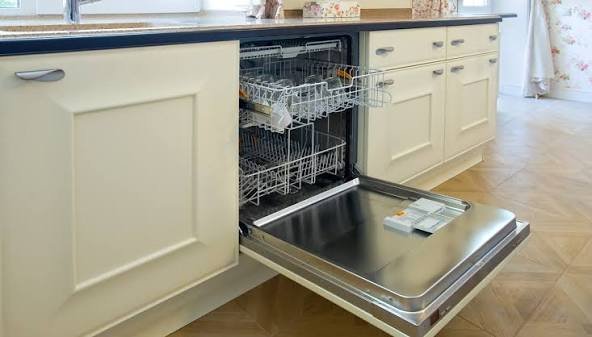
The 50% Rule serves as the primary financial threshold across the appliance repair industry. The principle states that if the comprehensive cost of a repair inclusive of genuine replacement parts, technical labor, and diagnostic fees amounts to less than 50% of the purchase price of a comparable brand-new unit, repairing the appliance is almost always the more cost-effective choice. This guideline is grounded in asset depreciation: an otherwise sound dishwasher that receives a targeted component replacement still retains the vast majority of its useful operating lifespan.
Where the Rule Falls Short
While the 50% Rule provides a quick baseline filter, treating it as an absolute rule often leads to flawed decisions. The calculation fails to account for three critical variables: the overall chronological age of the machine relative to its design lifespan, the historical frequency of prior breakdowns, and whether the failing component indicates wider internal wear. A repair that costs 40% of a new machine might look sound on paper, but if that machine is already nine years old and operating on its second motor, spending that capital represents a losing investment.
Does the Dishwasher’s Age Change the Answer?
Under 5 Years Old: The Prime Operational Window
For dishwashers under five years of age, authorizing a repair is almost universally the correct financial decision. While factory benchmarks project a 10 to 12 year lifespan, mineral-heavy water and ambient kitchen heat explain why dishwashers fail faster in Dubai without regular descaling. At this early stage, core mechanical systems remain structurally sound, making a targeted component repair the most sensible long-term investment.
5 to 8 Years Old: The Intermediate Evaluation Zone
Dishwashers within the five-to-eight-year bracket represent the transitional phase where repair decisions must be weighed with precision. An isolated, low-to-moderate repair cost still delivers strong value if the appliance has enjoyed a clean service history. However, if the machine experiences a second major electrical or hydraulic failure within a twelve-month span, it signals that thermal and mechanical fatigue are spreading through the system. In this scenario, future repair risks often outweigh the short-term savings of patching the current fault.
Beyond 8 Years Old: The Approaching End-of-Life
Once a dishwasher crosses the eight-year threshold, it enters its terminal operational phase. At this lifecycle stage, internal seals dry out, electrical relays become brittle, and circulation motors operate under severe wear. While minor, low-cost maintenance such as clearing a drain clog or replacing a door gasket remains sensible, any complex repair approaching thirty to forty percent of a new unit’s value should be bypassed in favor of a full system replacement.
Which Faults Almost Always Favor Repair?
A sudden operational failure does not automatically indicate that a dishwasher has reached terminal decline. Many common issues are isolated to inexpensive, high wear peripheral parts that can be swapped out quickly without affecting the core mechanics:
Perimeter Door Gasket Failures
A leaking door is almost always caused by a degraded, torn, or mineral-crusted rubber gasket. If water is escaping from the front of your machine during a wash cycle, read our troubleshooting guide on how to fix a dishwasher leaking from the door to inspect seal integrity, door latches, and spray arm alignment.
Spray Arm Cracking or Nozzle Blockages
When dishes emerge dirty from the upper rack, the culprit is frequently a cracked rotating spray arm or nozzles choked with hard water limescale. Replacing or descaling the spray assembly is a routine, inexpensive fix that immediately restores wash pressure.
Drain Pump Filter and Hose Blockages
Standing water in the base of the tub is commonly caused by foreign objects such as broken glass, toothpicks, or compacted food debris jamming the drain impeller. Clearing the filter well or installing a fresh drain hose is a quick, low-cost procedure that completely resolves the issue.
Water Inlet Solenoid Valve Malfunctions
A dishwasher that hums continuously without filling with water, or takes an unusually long time to complete cycles, typically suffers from a calcified inlet valve. Swapping out the faulty solenoid restores immediate water intake without placing financial strain on the household.
Which Faults Often Favor Replacement?
Control Board Failures on Older Units
A failed control board is one of the more expensive dishwasher repairs, and on a unit already past 6-7 years old, the repair cost frequently approaches or exceeds the 50% threshold, making replacement the more sensible choice.
Motor Failures
Motor replacement is similarly costly, and combined with a unit’s age, often tips the decision toward replacement rather than repair, particularly since a failed motor sometimes indicates broader wear across the unit.
Recurring Faults on the Same Unit
A unit that’s needed two or more separate repairs within a year, even if each individual repair was inexpensive, is showing a pattern worth weighing against a new unit’s reliability, even when no single repair alone crosses the 50% threshold.
What a New Dishwasher Actually Costs in Dubai
A comparable new dishwasher in Dubai typically ranges from AED 1,200 to 3,500+ depending on brand and features, with installation adding a modest amount on top for built-in units specifically. Having this range in mind before comparing it against a specific repair quote makes the 50% calculation concrete rather than abstract. Buyers should also factor in energy efficiency ratings when comparing units, since guidance from UAE consumer and energy efficiency standards shows a more efficient new unit can meaningfully offset its higher upfront cost over several years of use.
A Practical Decision Checklist
Repair generally makes sense when the unit is under 6-7 years old, the repair cost is comfortably under half a comparable new unit’s price, and this isn’t the second major repair within the past year. Replacement generally makes more sense when the unit is approaching or past 8 years old, the repair involves the control board or motor specifically, or repeated faults have already occurred. An experienced appliance technician can give an accurate, specific repair quote to run through this exact framework, rather than relying on general estimates.
FAQs
Is it ever worth replacing a dishwasher for a very cheap repair, just to upgrade features?
This comes down to personal preference rather than a pure cost decision. If the current unit is functioning well otherwise, most people find more value in waiting until an actual fault occurs before replacing it.
Does brand affect the repair vs replace decision?
Somewhat. Premium brands like Bosch, Siemens, and Miele tend to have higher replacement costs but also longer expected lifespans, which can shift the calculation slightly in favor of repair even at a higher repair cost.
How long does dishwasher installation typically take when replacing an old unit?
For a straightforward like-for-like replacement, installation is usually completed within a few hours, though built-in units requiring cabinetry adjustments can take longer.
Is it worth repairing a dishwasher that’s still under manufacturer warranty regardless of age?
Yes, generally. If a fault is covered under an active warranty, repair is almost always the right call regardless of where the unit falls in the age or cost framework above.
Can a technician tell during the first visit whether repair or replacement makes more sense?
In most cases, yes. Once the specific fault is diagnosed and a repair cost is quoted, running that number against the unit’s age and this framework usually gives a clear answer on the spot.