
A washing machine DIY checks routine before calling a technician can resolve a genuine share of issues without needing a visit at all, and for the ones that do need a professional, it means the technician arrives with the simple causes already ruled out, which usually means a faster, more accurate diagnosis. This isn’t about attempting an actual repair independently, it’s about the handful of checks anyone can safely do in a few minutes.
This guide consolidates the quick checks worth running across the most common situations, power issues, drainage problems, a machine that won’t start, into one place, rather than repeating diagnostics already covered in depth elsewhere in this guide.
Jump to a section:
- Power and Connection Checks
- Load-and-Balance-Checks
- Checks for a Machine That Won’t Drain or Spin Fully
- Water Supply and Drainage Checks
- Checks for Excess Suds or Detergent Residue
- Checks Specific to a Machine Not Starting
- Quick External Checks on the Machine Itself
- When to Stop Checking and Call a Technician
Power and Connection Checks
Is the Machine Actually Getting Power?
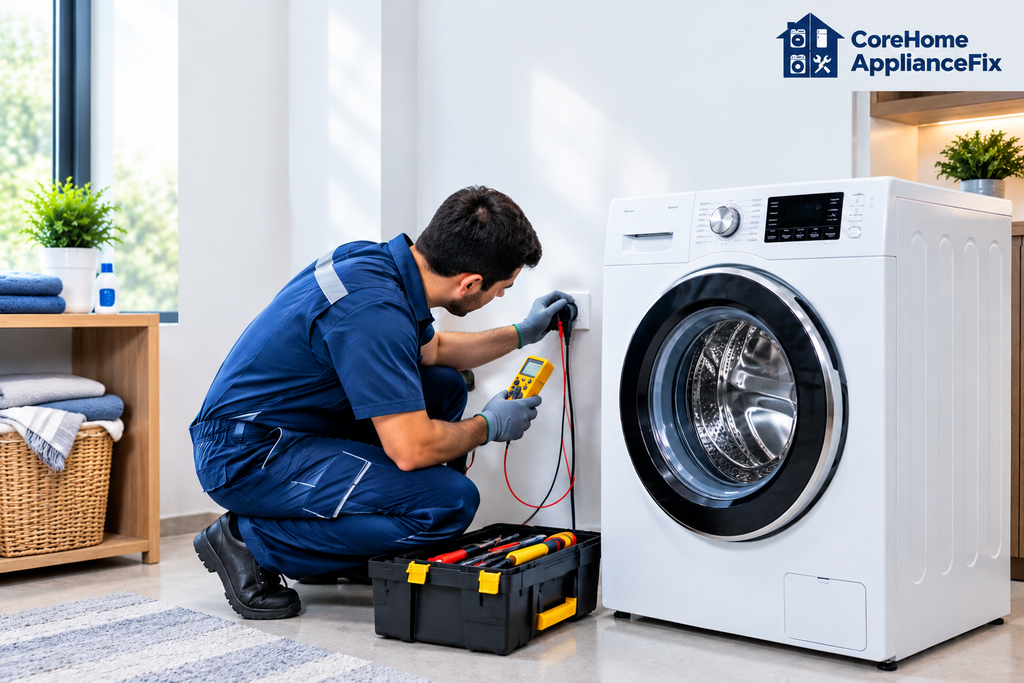
Check that the plug is fully seated in the outlet, and if the outlet is on a switch, confirm the switch is on. This sounds obvious, but a partially seated plug or an accidentally flipped switch is a genuinely common cause of a machine that seems completely dead.
Has a Breaker Tripped?
Check the home’s electrical panel for a tripped breaker on the circuit powering the machine. If it has tripped once, resetting it and trying the machine again is reasonable, but a breaker that trips again immediately points to an electrical fault that shouldn’t be tested repeatedly, and is worth a technician’s inspection instead.
Is the Machine’s Door or Lid Fully Closed?
Most machines, particularly front-load models, won’t start at all unless the door is fully closed and the lock has engaged. Checking that nothing, a stray piece of clothing or a loose item, is preventing the door from closing completely resolves this quickly.
Load and Balance Checks
Is the Load Too Small or Too Large?
An extremely small load, sometimes just one or two items, can prevent the machine from balancing properly during spin, causing it to pause or stop the cycle as a safety measure. Adding one or two extra items, or running a slightly larger load, often resolves this without any repair needed.
Is the Load Unevenly Distributed?
Heavy items, towels, bedding, bunched together on one side of the drum can trigger the same imbalance response. Pausing the cycle and redistributing the load evenly around the drum before restarting usually clears this.
Checks for a Machine That Won’t Drain or Spin Fully
Check whether the load is genuinely too heavy for the cycle selected, an overloaded drum can prevent a full spin even with nothing actually wrong. Listen closely for a coin, button, or small object rattling inside the drum or against the door, since small items caught in the wrong place can interfere with a full cycle completing. If the load looks reasonable and nothing sounds obviously stuck, this points toward drainage rather than loading, and the full washing machine draining guide covers what to check next.
Water Supply and Drainage Checks
Is the Water Supply Valve Fully Open?
Check both hot and cold water supply valves behind the machine to confirm they’re fully open, not partially closed. A partially closed valve can cause slow filling or a machine that seems stuck rather than an outright fault.
Is the Drain Hose Kinked or Blocked at the Visible End?
Check the visible portion of the drain hose for any obvious kink or bend restricting flow. This is a quick visual check only, if the hose looks fine but drainage is still an issue, it points to one of the deeper drainage causes rather than something visible from the outside.
Checks for Excess Suds or Detergent Residue
Check whether more detergent than the load actually needs was used, excess suds from overdosing can cause a machine to pause, rinse repeatedly, or seem stuck trying to clear them. Confirming the detergent type matches the machine, high-efficiency machines need HE-labeled detergent specifically, rules out a common, easily self-caused issue that looks like a fault but isn’t one.
Checks Specific to a Machine Not Starting
Has the Correct Cycle Actually Been Selected?
Some cycle settings, particularly delay start or certain eco modes, can make a machine appear unresponsive when it’s actually just waiting or running a longer pre-phase than expected. Double-checking the selected program and any delay settings rules this out quickly.
Is the Child Lock Accidentally Enabled?
Many modern machines have a child lock feature that, if accidentally activated, prevents any buttons from registering. Checking the manual for the specific button combination to disable it resolves this in seconds once identified.
Quick External Checks on the Machine Itself
Check whether the machine rocks or wobbles during operation, which usually means it isn’t sitting level rather than anything internally wrong, and adjusting the feet resolves this in minutes. Look underneath and around the machine for any visible water, even a small amount can indicate a loose hose connection worth tightening before assuming a bigger leak. Glance at the power cord for any visible fraying or damage, since a damaged cord is a genuine safety risk worth addressing immediately, in line with Dubai Civil Defence’s home electrical safety guidance, regardless of whether the machine seems to be working fine otherwise.
When to Stop Checking and Call a Technician
If these checks don’t resolve the issue, or if there’s any burning smell, unusual noise, or repeated breaker tripping, this is the point to stop testing further and book a washing machine technician rather than continuing to experiment. These checks are meant to rule out the simple, safe-to-check causes, not to diagnose an actual mechanical or electrical fault.
FAQs
How long should these checks take before deciding to call a technician?
Most of these checks take 10 to 15 minutes combined. If the issue isn’t resolved after working through the relevant ones for the specific symptom, it’s reasonable to stop and book a visit.
Is it safe to keep resetting a tripped breaker to test the machine?
A single reset to test the pattern is fine. Repeated resets after it trips again risk worsening an electrical fault and shouldn’t be attempted more than once or twice.
Can an unbalanced load actually damage the machine if ignored repeatedly?
Yes, over time. Repeated unbalanced loads put extra strain on the drum suspension and bearings, so it’s worth correcting each time rather than letting the machine repeatedly pause and restart on its own.
Does checking these things void the warranty if something is actually broken?
No. These are external, non-invasive checks, plugs, valves, load balance, not internal repairs, so they don’t affect warranty coverage in any way.
What’s the most commonly overlooked check on this list?
The water supply valve being partially closed and an accidentally enabled child lock are both surprisingly common and easy to overlook, since neither is obviously connected to the symptom being experienced.