
Dubai’s climate is simply harder on an air conditioner than almost anywhere else it might operate. Extreme heat forces longer cooling cycles, fine desert dust works its way into filters and coils, humidity speeds up corrosion, and near year-round usage gives components far less rest than they’d get elsewhere. Together, these four factors are why AC units break down faster in Dubai than in milder climates.
Heat, dust, humidity, and near-continuous runtime each place their own separate strain on different parts of the system, and most units breaking down early are dealing with a combination of several of these factors at once rather than just one. This guide breaks down each factor individually, what it actually does to the system over time, and what meaningfully slows the process down.
Jump to a section:
- Does Dubai’s Heat Force AC Units Work Harder?
- Does Desert Dust Speed Up Wear and Tear?
- Does Near-Constant Summer Usage Shorten Lifespan?
- Does Humidity Affect Component Life?
- Is Incorrect Unit Sizing a Factor?
- Does Skipping Regular Maintenance Accelerate Breakdown?
Does Dubai’s Heat Force AC Units Work Harder?
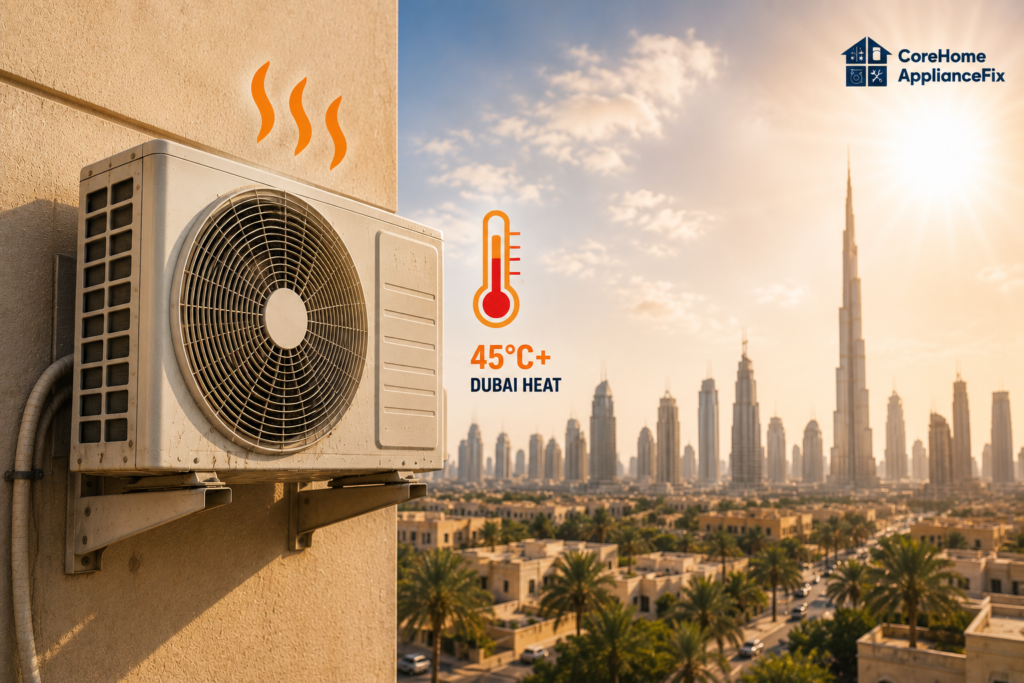
Extreme summer temperatures push an AC system to run at near-maximum capacity for hours at a time, rather than cycling on and off the way it would in a milder climate.
Is the Unit Running Longer Cycles Than Normal?
A unit constantly fighting a large gap between outdoor and target indoor temperature runs longer, less efficient cycles that place continuous strain on the compressor and motor.
How to Check: Notice whether the system runs almost continuously through peak afternoon hours rather than cycling off periodically, even with the thermostat set to a reasonable target.
Solution: Setting the thermostat around 24°C rather than pushing for a much larger temperature drop reduces how hard the compressor has to work during peak heat. Shading windows and reducing heat gain into the room also lowers the load the system has to fight against.
Is the Compressor Under Constant Strain?
The compressor is the component most directly affected by extended high-heat operation, since it is doing the bulk of the work during long cooling cycles.
How to Check: This is not something to assess visually. A compressor under chronic strain typically shows up as reduced cooling efficiency or unusual noise well before a full failure.
Solution: Regular servicing that includes compressor load testing catches early strain before it becomes a full breakdown. A professional AC service can flag whether a specific unit is being pushed beyond what is reasonable for its size and rating.
Does Outdoor Unit Placement Make Heat Exposure Worse?
An outdoor unit installed in direct, unshaded sun works harder to release heat than one with even partial shade or airflow around it.
How to Check: Look at where the outdoor unit is positioned and whether it sits in full sun for most of the day, particularly during peak summer months.
Solution: Where possible, adding shade without blocking airflow, such as a properly ventilated cover, reduces the heat load on the unit. This is a longer-term consideration for new installations rather than something to retrofit if the unit is already in a fixed position.
Does Desert Dust Speed Up Wear and Tear?
Dubai’s fine desert dust is smaller and more pervasive than dust in most other climates, and it works its way into places a standard air filter cannot fully catch.
Is Dust Building Up on the Condenser Coils?
Dust settling on the outdoor condenser coils reduces how effectively the unit releases heat, forcing the compressor to work harder to compensate.
How to Check: Inspect the outdoor unit’s coils and fins for a visible layer of dust or grime, particularly after sandstorms or extended dry, windy periods.
Solution: Coils should be gently brushed clean rather than blasted with a high-pressure hose, which can bend the fins. Scheduling this as part of routine servicing rather than waiting for visible buildup keeps the load on the compressor consistent year-round.
Is Dust Clogging the Air Filter Faster Than Expected?
Dubai’s dust load means filters clog significantly faster here than the standard intervals recommended for most climates.
How to Check: Pull the filter and hold it to light every few weeks rather than waiting the full one to three month window typically recommended elsewhere.
Solution: Cleaning or replacing filters closer to every three to four weeks during peak dust or sandstorm periods prevents the severe airflow restriction that causes indoor coils to freeze. If your system is already blowing warm or room-temperature air, read our troubleshooting guide on why your AC is not cooling in Dubai to resolve the cooling issue.
Is Fine Dust Reaching Internal Electrical Components?
The finest desert dust particles can work their way past filters and settle inside the unit’s electrical panel and internal components over time.
How to Check: This is not something to inspect without opening the unit. Repeated electrical faults or PCB issues on a unit with otherwise normal usage can point to accumulated internal dust.
Solution: A full internal clean during scheduled servicing, rather than just filter and coil maintenance, addresses this before it leads to an electrical fault. This is a technician-level task rather than a DIY step, since it involves opening the unit’s internal panel.
Does Near-Constant Summer Usage Shorten Lifespan?
Most AC units elsewhere run seasonally, with long stretches of rest during cooler months. In Dubai, many units run close to year-round, which changes how quickly components wear out.
Are Components Wearing Out From Total Runtime Hours?
Every mechanical component has a general lifespan measured in runtime hours, and a unit running nine or more months a year accumulates those hours far faster than one running three or four.
How to Check: This is not something to assess directly, but a unit installed at the same time as one in a milder climate reaching breakdown age years earlier is the practical result of this difference.
Solution: There is no way to avoid runtime hours in Dubai’s climate, but staying ahead of servicing intervals based on actual usage, rather than a generic annual schedule, helps catch wear before it becomes a breakdown. Units running nearly continuously benefit from the six-month servicing schedule rather than a once-a-year check.
Is the Unit Getting Any Rest Periods At All?
Continuous operation without any downtime does not give components the chance to cool down and settle the way intermittent use allows.
How to Check: Consider whether the unit runs 24 hours a day for extended stretches, particularly in bedrooms or spaces occupied around the clock.
Solution: Where comfort allows, using a slightly higher overnight temperature setting or a scheduled off period during naturally cooler hours reduces total runtime without a noticeable comfort tradeoff. This is a usage adjustment rather than a repair, and it meaningfully extends component life over several years.
Does an Annual Maintenance Plan Help Offset Constant Use?
A unit running this many hours needs maintenance frequency to match, rather than the standard schedule built for lighter, seasonal use.
How to Check: Compare the unit’s actual servicing history against the six-month interval recommended for Dubai’s usage patterns.
Solution: An annual maintenance plan built around consistent, scheduled servicing catches the early signs of runtime-related wear, such as declining efficiency or early compressor strain, before they turn into a full breakdown.
Does Humidity Affect Component Life?
Dubai’s humidity swings, particularly in coastal-adjacent and summer-humid periods, introduce a different kind of wear than heat or dust alone, one tied to moisture and corrosion.
Is Moisture Accelerating Corrosion on Metal Components?
Persistent humidity around the outdoor unit’s metal fins, coils, and electrical connectors gradually promotes corrosion, particularly in units installed close to the coast.
How to Check: Look for any discoloration, rust spots, or a whitish buildup on the outdoor unit’s metal components, especially around joints and connectors.
Solution: Early corrosion can often be cleaned and treated during a routine service before it affects performance. Units already showing significant rust on structural or electrical components need a technician to assess whether affected parts require replacement.
Is High Humidity Increasing the Cooling Load?
This is largely an inherent part of operating in Dubai’s climate rather than something to fix directly, but keeping the system well-maintained, particularly clean coils and correct refrigerant levels, ensures it is not working harder than necessary on top of the humidity load already present, an important factor given DEWA’s consumer tips on reducing cooling-related energy consumption.
How to Check: This is not something to observe directly, but noticeably higher energy bills during humid months compared to drier ones, even with consistent thermostat settings, points to this added load.
Solution: This is largely an inherent part of operating in Dubai’s climate rather than something to fix directly, but keeping the system well-maintained, particularly clean coils and correct refrigerant levels, ensures it is not working harder than necessary on top of the humidity load already present.
Is Trapped Moisture Affecting Internal Components?
Beyond the musty smells covered elsewhere, trapped internal moisture during high-humidity periods can also affect electrical components over time if drainage or airflow issues go unaddressed.
How to Check: A pattern of recurring electrical faults on a unit with otherwise normal maintenance can point to unresolved moisture issues inside the unit rather than a standalone electrical problem.
Solution: Addressing drainage and airflow issues promptly prevents moisture from damaging sensitive electronics. If trapped moisture is already causing unpleasant odours to blow through your home, check our guide on fixing bad AC smells in Dubai for proper coil sanitization and drain line clearing steps.
Is Incorrect Unit Sizing a Factor?
A unit that is the wrong size for the space it is cooling wears out faster than a correctly sized one, regardless of how well it is otherwise maintained, and this is a more common issue in Dubai than it might seem.
Is the Unit Undersized for Space?
An undersized unit runs constantly trying to reach a target temperature it is not powerful enough to maintain, placing chronic strain on the compressor.
How to Check: Notice whether the unit runs almost continuously without ever quite reaching the set temperature, particularly in larger rooms or open-plan spaces.
Solution: A technician can assess whether the unit’s capacity actually matches the room size and heat load. If it is undersized, this is a capacity issue rather than a fault, and no amount of repair will fully resolve it. Upsizing at the next replacement is the practical long-term fix.
Is the Unit Oversized for Space?
An oversized unit cools the space quickly but shuts off before properly removing humidity, leading to short, inefficient cycling that also strains components over time.
How to Check: Notice whether the room feels cold quickly but still humid or clammy, with the unit cycling on and off frequently in short bursts.
Solution: This is also a sizing issue rather than something fixable through repair. A correctly sized replacement at the next unit change resolves both the comfort issue and the added mechanical strain from short-cycling.
Was the Unit Sized for Dubai’s Climate Specifically?
A unit sized using general capacity guidelines rather than Dubai-specific heat load calculations can end up mismatched even if it looks correctly sized on paper.
How to Check: This is difficult to assess without a professional load calculation, but a unit that has never quite performed well since installation, despite regular maintenance, points to a possible sizing mismatch from the start.
Solution: A proper heat load assessment, factoring in Dubai’s specific climate conditions rather than generic sizing charts, ensures any replacement unit is matched correctly from the outset. This is worth requesting explicitly when a unit is being replaced rather than assuming standard sizing guidelines apply.
Does Skipping Regular Maintenance Accelerate Breakdown?
Every factor covered so far, heat, dust, humidity, runtime, and sizing, compounds faster when regular maintenance is skipped, since maintenance is what catches each of these strains before they turn into failures.
Is the Unit Overdue for Servicing?
A unit running past its recommended service interval accumulates small issues that would otherwise be caught and corrected early.
How to Check: Check when the unit was last professionally serviced. Given Dubai’s conditions, anything beyond six months should be treated as overdue rather than the twelve-month interval common in milder climates.
Solution: Booking a full service covering filter cleaning, coil cleaning, refrigerant inspection, drain line clearing, and electrical testing catches the combined effects of heat, dust, and humidity before they compound into a larger failure.
Are Small Issues Being Left Unaddressed?
A minor issue such as reduced airflow, a faint smell, or a slight noise often gets ignored until it develops into a larger, more expensive failure.
How to Check: Consider whether any small symptoms, weaker cooling, occasional odd smells, minor noise, have been present for a while without being checked.
Solution: Addressing symptoms as soon as they appear, rather than waiting for a full breakdown, is consistently the more cost-effective approach in a climate that already places extra strain on every component.
Is the Unit on an Annual Maintenance Plan?
Units on a structured maintenance plan tend to reach breakdown age significantly later than those serviced reactively, only after something goes wrong.
How to Check: Compare whether the unit has a standing service schedule or has only ever been serviced in response to a specific problem.
Solution: Booking a professional AC checkup covering filter cleaning, coil cleaning, refrigerant inspection, drain line clearing, and electrical testing catches the combined effects of heat, dust, and humidity before they compound into a larger failure.
Final Thoughts
Dubai’s heat, dust, humidity, and near-constant runtime all place genuine strain on an AC system that units in milder climates simply do not face. None of these factors can be eliminated, but consistent maintenance, correct sizing, and addressing small issues early meaningfully slow down how quickly a unit reaches the point of major breakdown.
FAQs
How long should an AC unit last in Dubai compared to other climates?
An AC in a milder climate can often run 12 to 15 years, while units in Dubai typically show significant wear by 8 to 10 years due to heat, dust, humidity, and near-constant runtime combined.
Does regular servicing actually extend an AC’s lifespan in Dubai?
Yes, consistently. Units on a structured six-month servicing schedule reach breakdown age noticeably later than units serviced only when something goes wrong, since maintenance catches strain from heat and dust before it compounds.
Is it worth paying for an annual maintenance plan instead of one-off repairs?
For Dubai’s climate specifically, yes. The combination of heat, dust, and near-year-round usage means small issues develop faster here than in milder climates, and a structured plan catches them earlier than reactive, one-off servicing typically does.
Does the brand of AC matter for how long it lasts in Dubai’s climate?
Brand and build quality play a role, but climate factors affect every brand to some degree. A well-maintained mid-range unit often outlasts a premium unit that has been neglected, since maintenance frequency matters more than brand alone in this climate.
Can incorrect unit sizing really shorten an AC’s lifespan?
Yes. Both undersized and oversized units place additional strain on components through constant running or frequent short-cycling, and this cannot be fixed through repair, only through correct sizing at installation or replacement.
Should AC filters be cleaned more often in Dubai than the standard recommendation?
Yes. Standard filter cleaning intervals are typically built for less dusty climates. In Dubai, checking filters every three to four weeks during peak dust periods, rather than the standard one to three months, helps prevent the airflow restriction that accelerates wear.